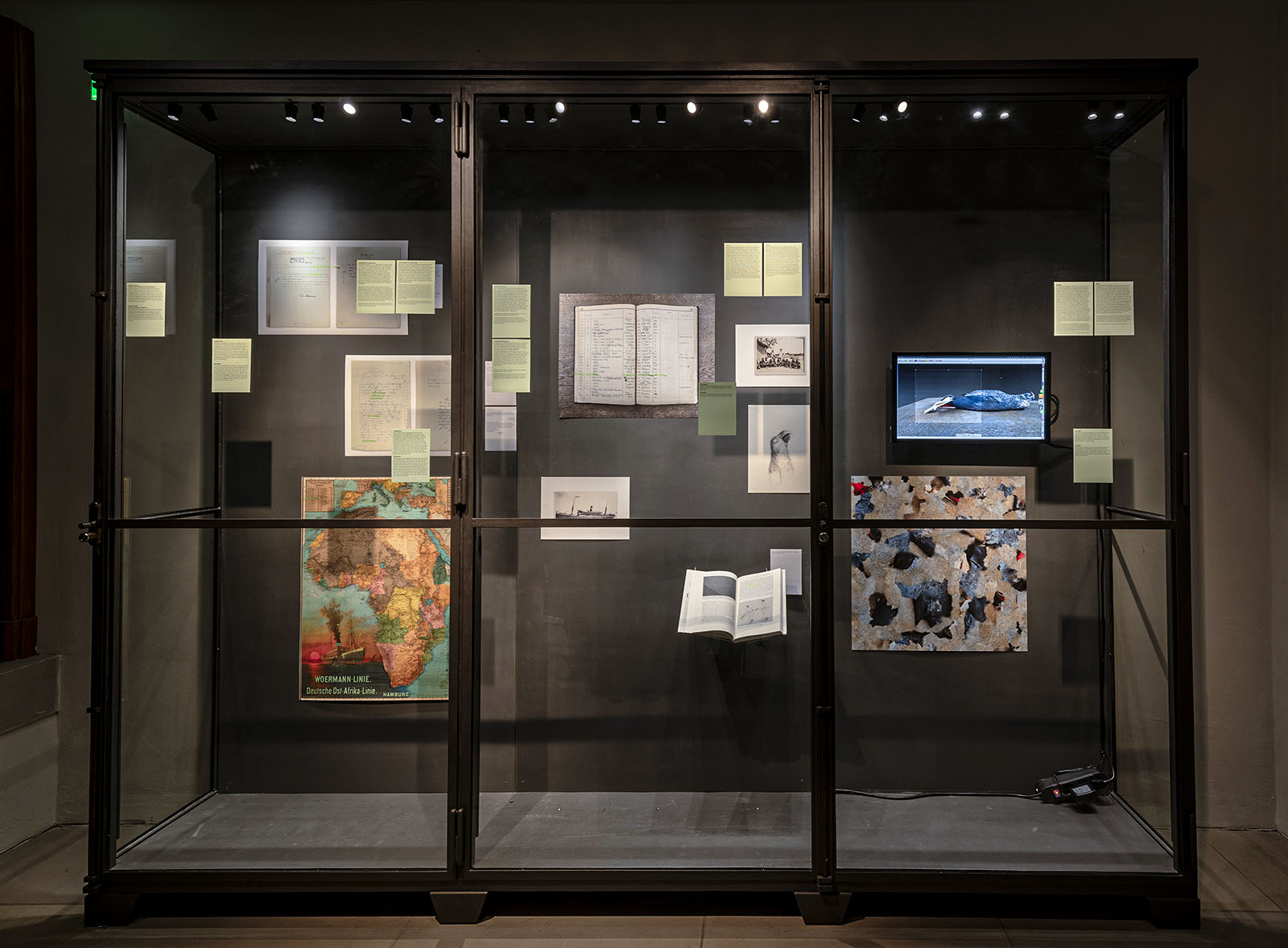
Installation view, TA T, Tieranatomisches Theater, Berlin
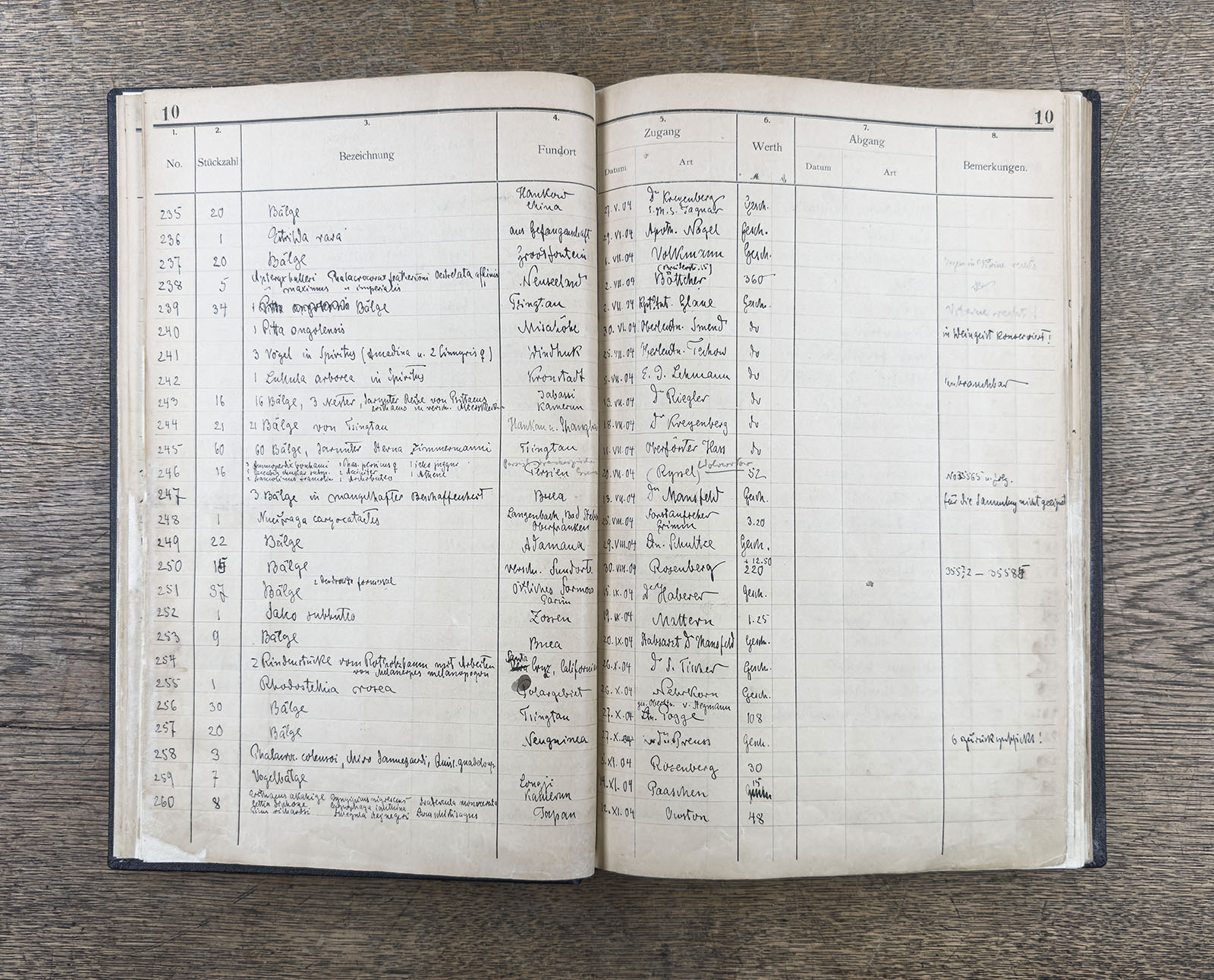
ACCESSION CATALOGUE
A shipment from the ‘German protectorates’ in Cameroon reached the Natural History Museum in Berlin (number 253) on 20 September 1904. It contained a total of nine bird skins.1 One of these skins is the grey parrot with the present-day inventory no. ZMB 2000.20042. The other eight birds in the shipment cannot be clearly assigned; three of them may have been another grey parrot (Psittacus erithacus), a Tullberg’s woodpecker (Campethera tullbergi) and a pygmy owl (Glaucidium sjoestedti). Buea in Cameroon, near the present-day Mount Cameroon National Park, is stated as the ‘Fundort’ (find location).2 The staff physician, Dr Alfred Mansfeld, colonial officer and station chief in Buea, is named under the heading ‘Zugang’ (accession). The heading ‘Werth’ (value) lists the entry ‘Gesch.’ (gift).
1 The term ‘bird skin‘ refers to a lying bird specimen that essentially comprises the bird‘s skin and feathers.
2 Similar to cultural artefacts, the find location can only be understood as an “approximation and invitation to further research”. The find locations often refer to collection points (see Atlas der Abwesenheit, Kameruns Kulturerbe in Deutschland, Reimer Verlag, 2023, p. 47).

THE ECONOMY OF COLLECTING
Mansfeld — like many other physicians, pharmacists and teachers among the colonial officials — worked as an ethnologist and ‘collector’.1 The items he collected included cultural belongings, human remains and the remains of non-human animals and plants. Mansfeld received a salary as a civil servant, which compensated him for his collecting activities for the museums. According to a Bundesrat (Federal Council) resolution of 1889 and supplementary legislation, colonial officials and military personnel were obliged to make the items they had collected available to the Royal Berlin Museums free of charge; they were legally obliged to donate them.

CONTACT POINT ROYAL MUSEUM OF ETHNOLOGY
Alfred Mansfeld’s shipments contained ethnological objects, prepared animal bodies and human remains. These were initially sent to the Royal Museum of Ethnology in Berlin. From there, the various items were distributed and in this case transferred to the Royal Zoological Museum (now the Museum of Natural History). It is possible that the bird whose journey we want to trace was in this shipment (see the listing of birds).
EQUIPMENT
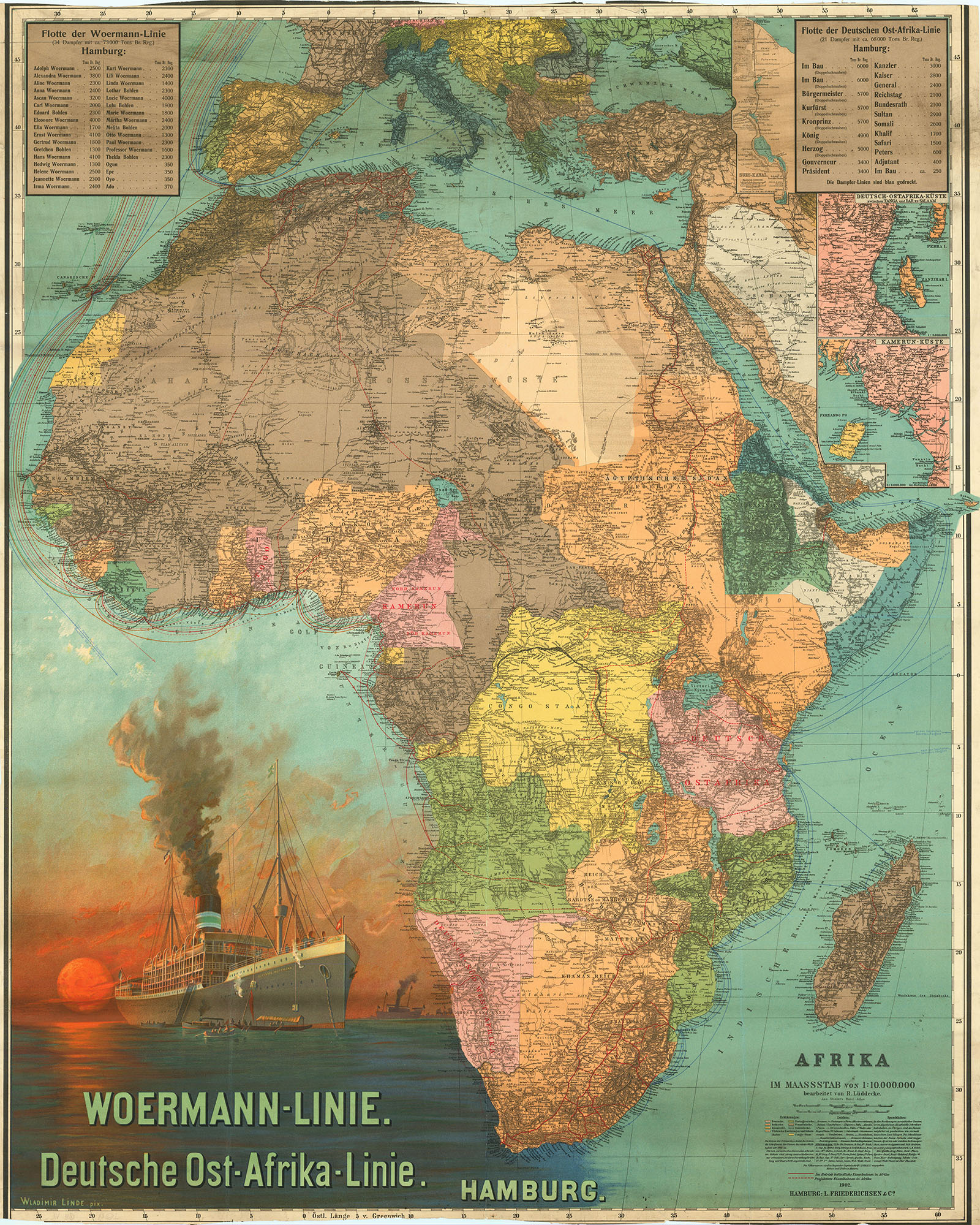
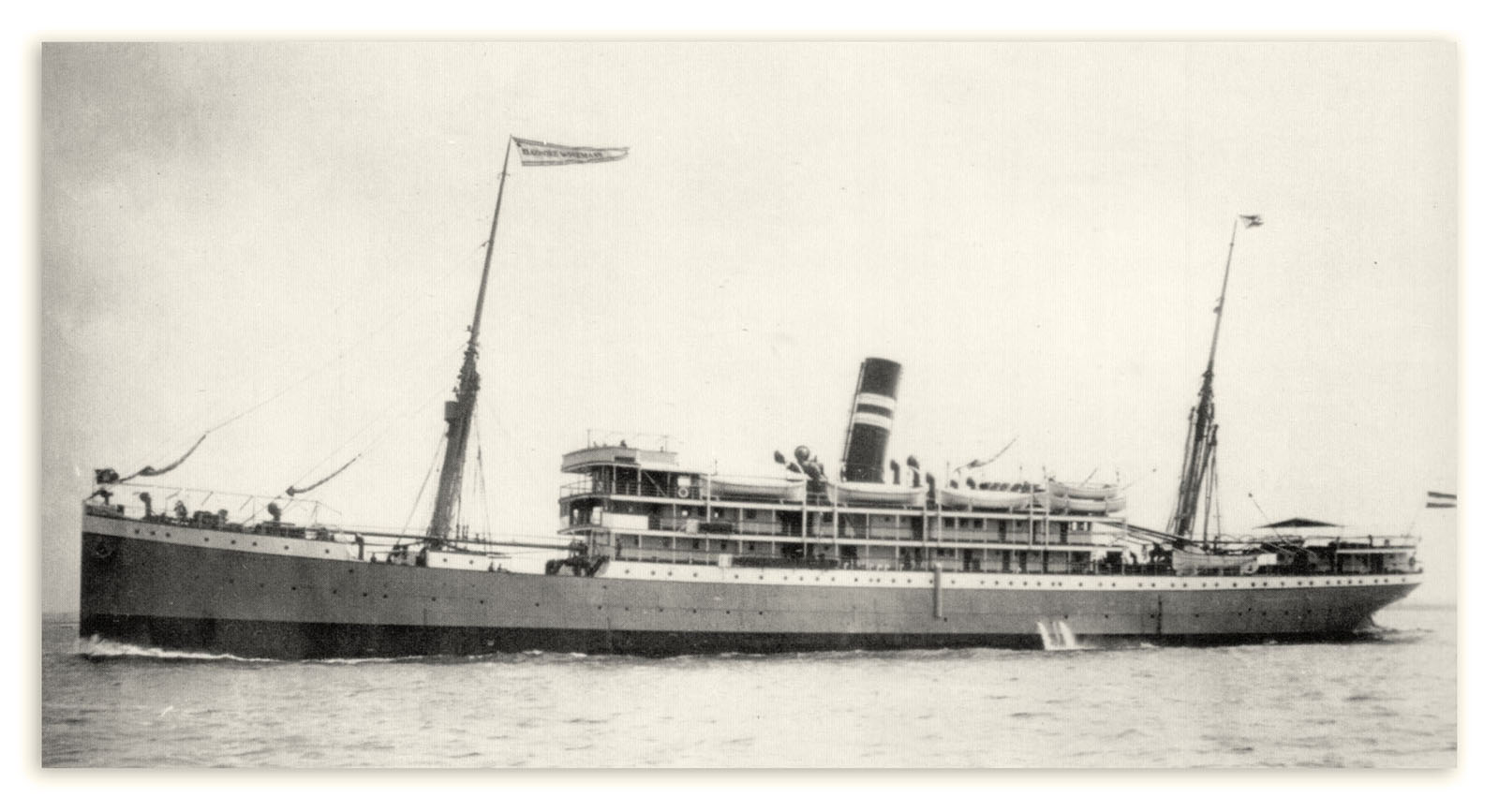
The museums provided the ‘collectors’ with everything they needed for their work. In return, Mansfeld obliged himself to supply animals of the same value. The equipment intended for Mansfeld left the port of Hamburg on the steamer Eleonore Woermann on 10 March 1904. The equipment list includes the following substances: 2.5 kg of arsenic soap (for preserving the bodies), 2.5 kg of alum (for preserving skins), 5 kg of potato flour (which was used to dry the bodies) and 1 kg of naphthalene (presumably for preserving the bodies in the transport crates).
TRANSPORT
The grey parrot was shipped by the Woermann Line, which dominated the entire German-African business at the time and made enormous profits. However, the Royal Berlin Museums only paid the shipping company half of the usual freight costs and benefited from the colonial politics and infrastructure. The passage from Douala (Cameroon) to Hamburg covered approximately 4,790 nautical miles. Perhaps this parrot was shipped on the same steamer that had transported Mansfeld’s equipment to Duala. The Eleonore Woermann was launched in 1902. It was, together with its sister ship, Lucie Woermann, one of the largest ships in the Woermann Line until 1904.
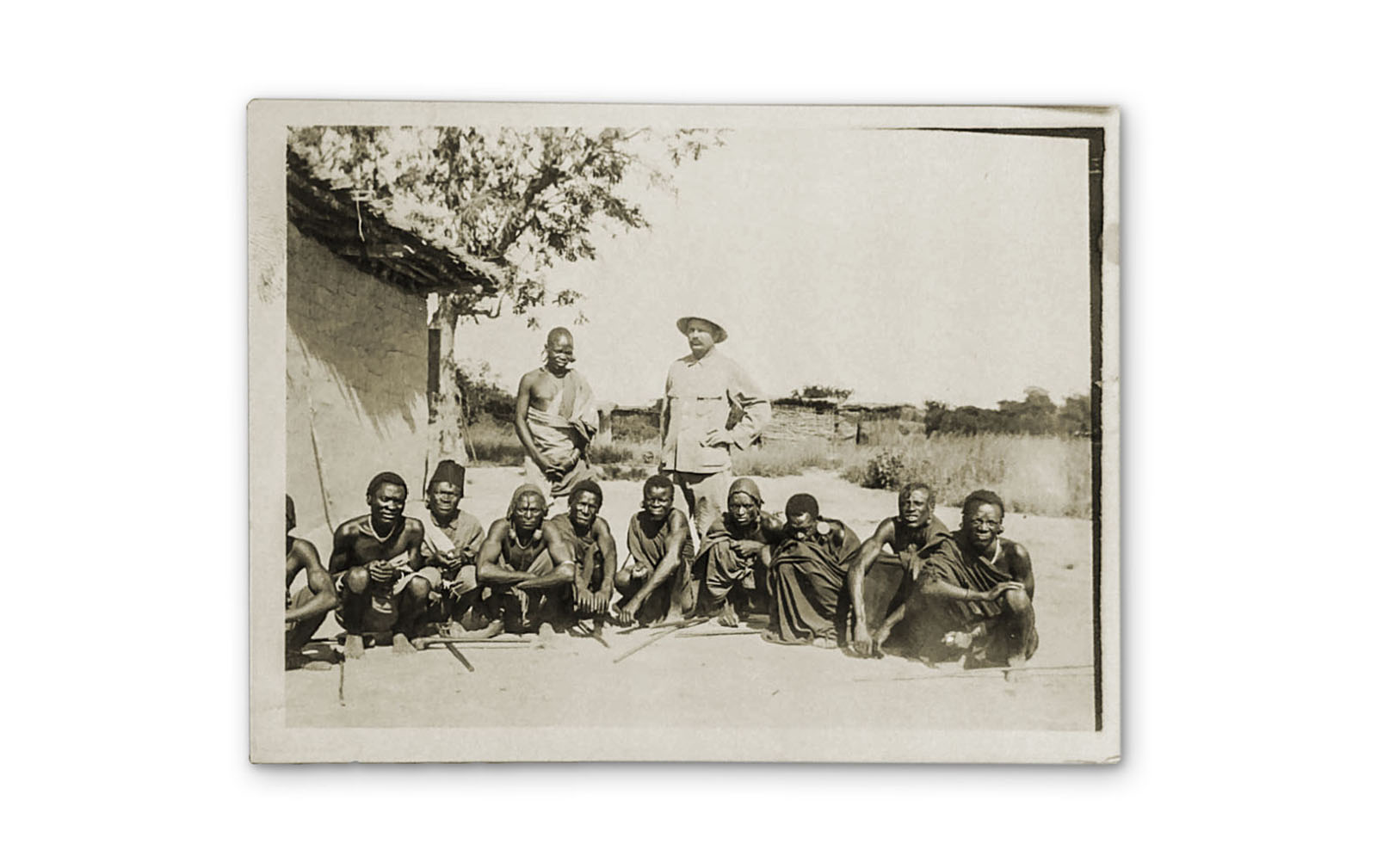
PHOTO
This photograph can be found right at the top of the files containing letters and collection lists from Alfred Mansfeld’s time in Cameroon (1904–1930). The enclosed envelope states contradictorily “4 photos from Tanzania”. It is unclear where the photo was taken and what role the locals play in this picture. But it is the only photograph in which locals can be seen together with Mansfeld. Perhaps they worked for him, as ‘collectors’ in the colonies often relied on the knowledge and skills of the locals, for example, as hunters, informants or taxidermists. However, they are hardly mentioned in the files of the ‘collectors’ or in the archives. We can, therefore, only make assumptions based on what we know, for example, about the working conditions in the former colonies: Perhaps the parrot was tracked down by one of the men in the photo and killed for the collection? Perhaps one of them treated the animal’s body with arsenic and contracted poisoning in the process? As is usual in these photos, Mansfeld can be seen in a colonial pose.
BODY
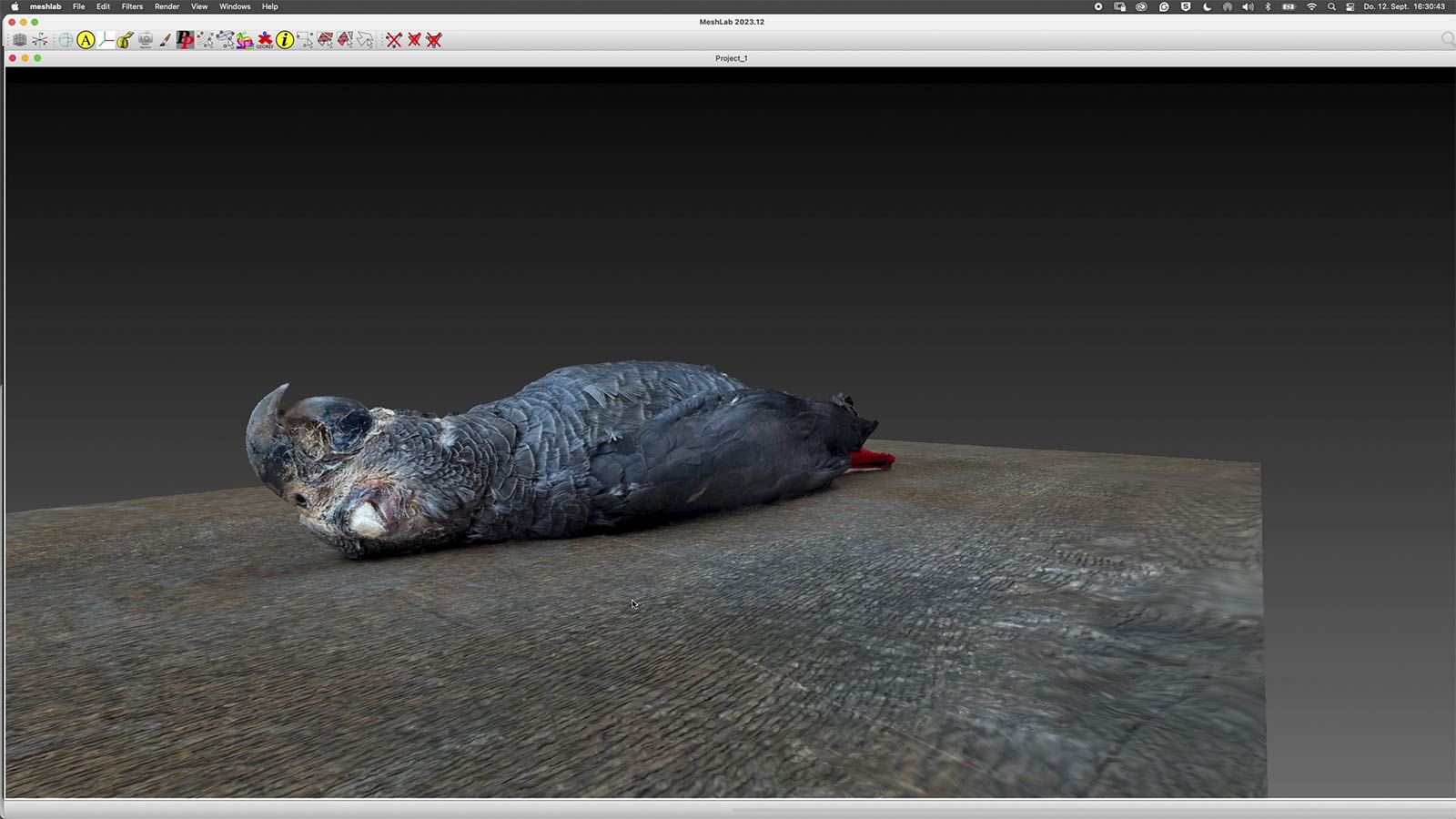
The body of the bird is 34.5 cm long and, according to the collection list, it is an adult. Those who saw the animal before preparation could recognize its life stage by the iris of the eyes – juveniles have a grey iris, adults a light yellow one. The sex of the parrot is unknown.3 The weight of the dried and stuffed body is 122 g (by comparison, a live grey parrot weighs approx. 500 g). If he or she was killed by locals, bows and arrows, slingshots or traps may have been used. Europeans preferred to use firearms.4 The body shows traces of preparation: There is a seam on the underside of the neck. The parrot was probably prepared and preserved on-site as a skin. Arsenic was a common preservative circa 1904 (see the list of equipment). The body of the grey parrot is, therefore, toxic and should not be handled without protective gloves. Spending time in the archive rooms where the animal bodies are kept is a health hazard for scientists and museum staff. The animal remains can potentially be preserved forever.
3D SCAN
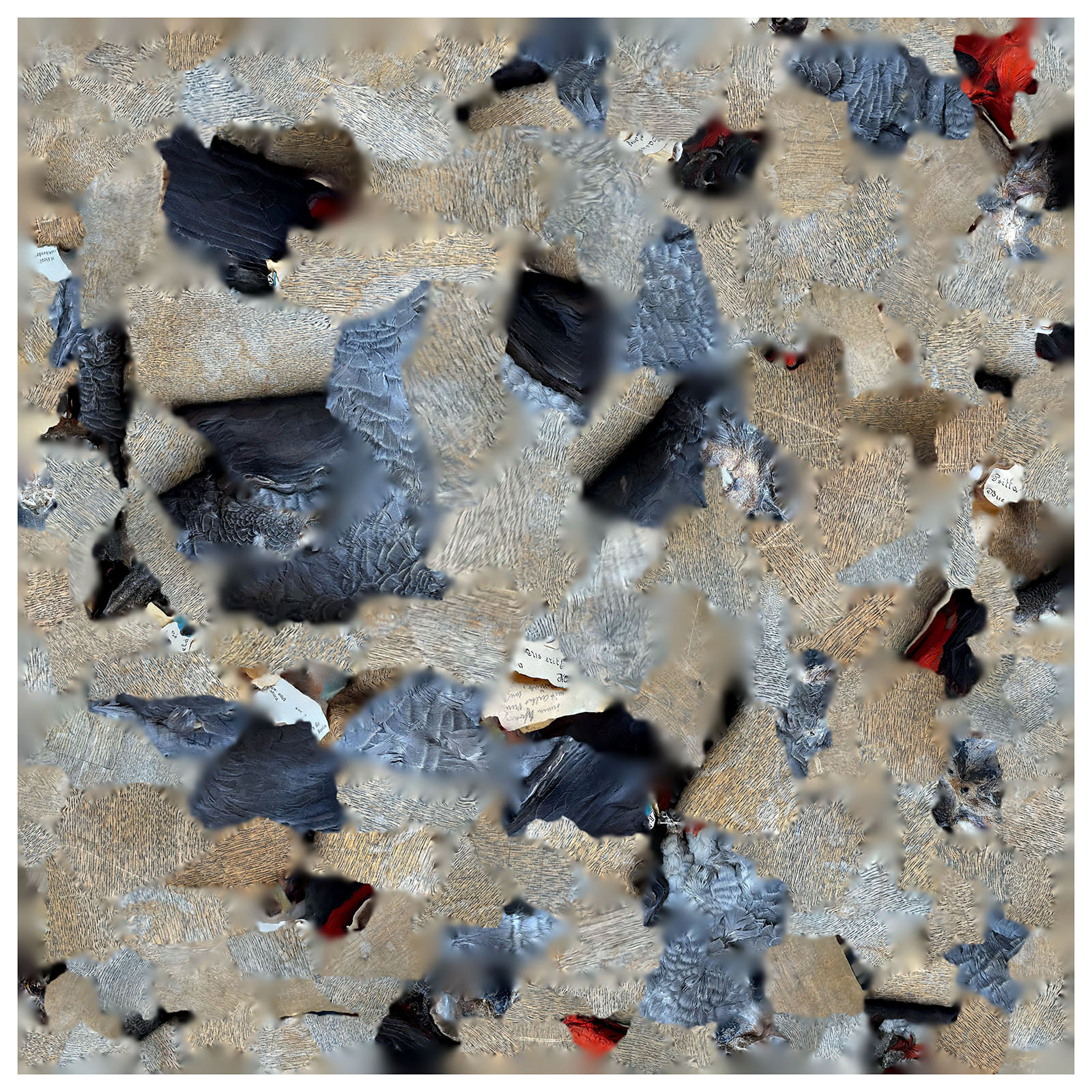
The 3D scan of the grey parrot was made by photogrammetry based on photographs of the animal’s body and image measurements of its position and shape. The square surface displayed here is the texture of the 3D object. It depicts both the surface of the body and that of the table on which the body rests.
3 The sex cannot be determined from the morphology of the skin, but a DNA sample could provide information. The analysis is not easy due to the ageing of the body remains and the influence of various biocides, such as arsenic, mercury and DDT, which were used and contaminated the animal bodies. The analysis may or may not be successful.
4 See Nancy Jacobs, Birders of Africa, Yale University Press, 2016
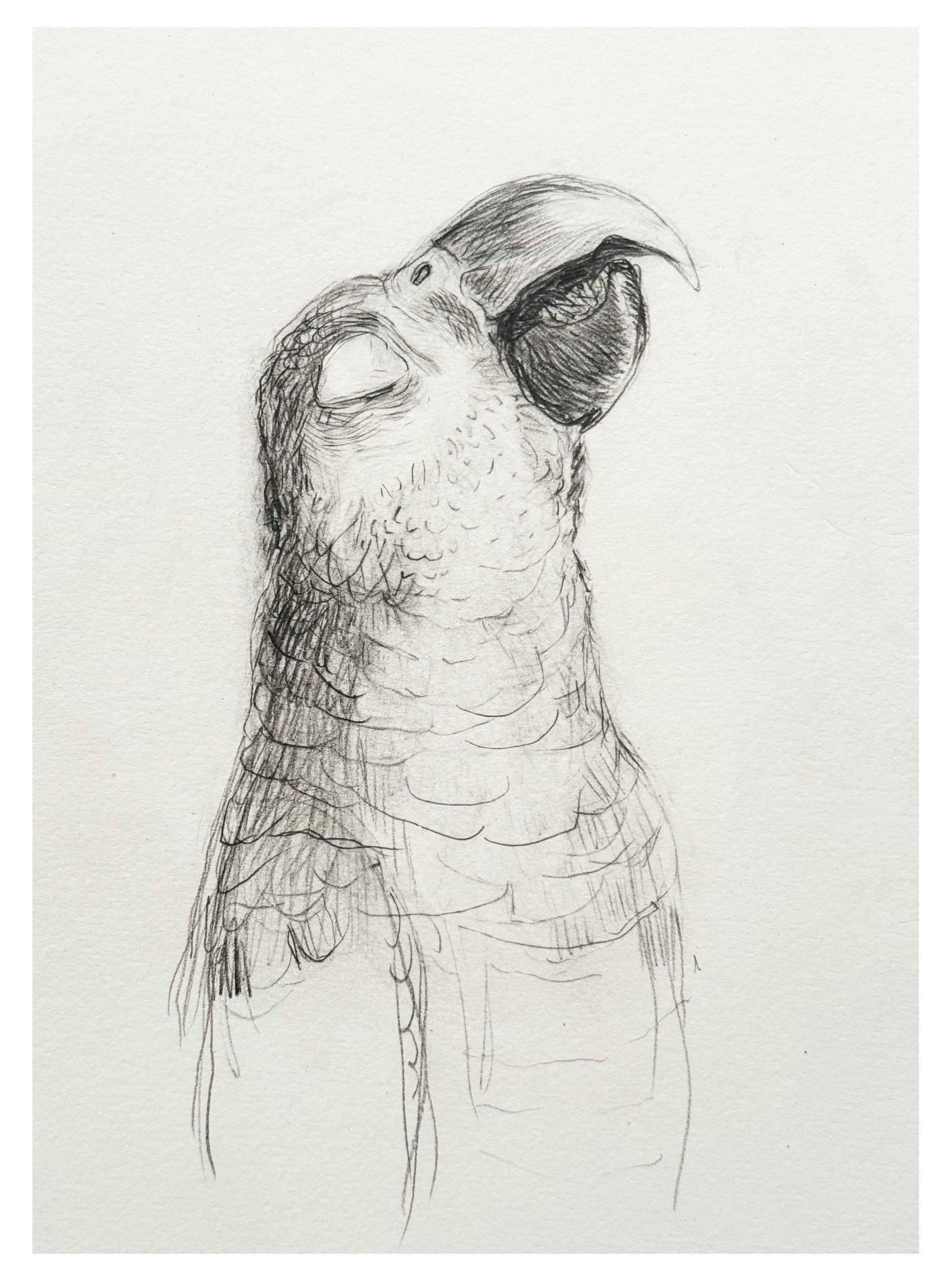
DRAWING
The portrait of the grey parrot was created on 20 August 2024. It was drawn by Ute Hörner with pencil on paper.
One of Thirtysix
Die Künstler*innen haben zusammen mit Wissenschaftlerinnen des Museums für Naturkunde Berlin einen Graupapagei aus der Sammlung ausgewählt. Sie/er wurde 1904 im Eingangsbuch der naturkundlichen Sammlung registriert. Hörner/Antlfinger haben basierend auf den Akten des ‚Sammlers‘, Briefwechseln zwischen ihm und den Institutionen sowie Listen mit Ausrüstungsmaterial eine kritische Erzählung über den Papagei entwickelt. Dabei versuchen sie, seinen Weg und den der Menschen, denen er begegnet sein könnte, nachzuvollziehen. Da es nur wenige zuordenbare Dokumente gibt, basiert vieles auf Vermutungen. Dennoch entsteht ein Bild davon, wie das ‚Sammeln‘ von nicht-menschlichen Anderen von statten ging, wer in den Aufzeichnungen erwähnt wird und wer nicht. Es zeigt sich, wie fragil das Wissen über die tierischen Körper und ihre Geschichte ist.
2024 Archivalien (Repros), Bleistift-Zeichnung, animierter 3D-Scan, Texte
Kooperationspartnerinnen: Dr. Sylke Frahnert, Dr. Katja Kaiser, Museum für Naturkunde Berlin (advice on the history of science)


